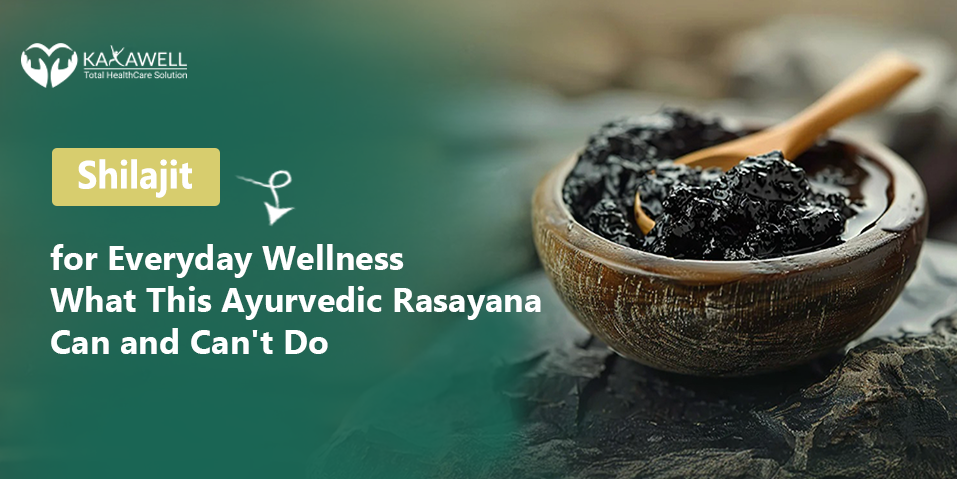
Shilajit for Everyday Wellness: What This Ayurvedic Rasayana Can — and Can’t — Do
In Ayurveda, shilajit is classed as a Rasayana — a rejuvenative meant to restore vitality — and it has re-entered Indian wellness routines in a big way. But between the social-media claims and the traditional reverence, it’s hard to know what shilajit actually does day to day. As an Ayurvedic physician who weighs classical use against modern evidence, here’s an honest guide to what this resin can realistically add to your wellness routine, and what it can’t.
Key takeaways
- Shilajit’s active compound is fulvic acid — an antioxidant — not the “85+ minerals” on most labels.
- Its most credible everyday benefit is support for energy and reduced fatigue; the data is promising but early.
- A modest testosterone effect is documented in older men — real, but not a treatment for low T.
- Claims around immunity, “detox,” and anti-ageing are not well established in humans.
- It’s only as good as it is pure — insist on lab-tested, heavy-metal-screened shilajit.
What shilajit actually is
Strip away the marketing and shilajit is a resin rich in fulvic and humic substances. The part that matters is fulvic acid, a small, highly active molecule that helps carry nutrients into cells and acts as an antioxidant — which is why classical Ayurveda called it Yogavahi, “the carrier.” The popular “85+ minerals” line is mostly a distraction: those minerals appear in trace amounts you’d already get from food, and they don’t determine how well a product works. Judge shilajit by its verified fulvic-acid content, not its mineral list.
What shilajit can do (the honest version)
This is where everyday users most want clarity, so let me separate the headline from the evidence.
The most relevant everyday claim is energy. A 2026 pilot study in Cureus gave active adults 500 mg a day for 28 days and reported reduced fatigue and a drop in C-reactive protein, a marker of inflammation. Encouraging — but it was small and open-label, so read it as promising, not proven.
The best-known finding is about testosterone: a randomized trial (Pandit et al., Andrologia 2016) found a roughly 23.5% rise in men aged 45–55 over 90 days on a purified extract. That’s real, but modest and physiological — not anabolic, and not a substitute for medical care if your testosterone is genuinely low.
So the fair summary is that shilajit is a reasonable, evidence-aware supplement for some people — most plausibly for energy and as an antioxidant support — rather than a miracle tonic. If you want to read the published human research and judge the studies yourself, that’s exactly the right instinct.
What shilajit can’t do
Equally important is what the evidence does not support. There is no robust human proof that shilajit “boosts immunity,” “detoxes” the body, or reverses ageing — these are marketing extrapolations, not trial results. It is also not a cure for any disease, not a replacement for sleep, movement, and a balanced diet, and not a fast-acting fix: any benefits build over weeks. Anyone promising dramatic, overnight results is overselling.
How to use it sensibly
For a generally healthy adult, the studied dose is about 250 mg twice daily of a purified extract. Traditionally it’s taken in the morning, dissolved in warm water or milk, away from tea or coffee. Give it 8–12 weeks before judging, then take a short break rather than using it indefinitely. Resin, powder, and capsules all work — the active compound is identical, so a tested capsule beats an unverified “premium” resin.
Who should avoid shilajit?
Even a clean product isn’t for everyone. Avoid shilajit if you are pregnant or breastfeeding, or if you have hemochromatosis or iron overload (it can increase iron absorption). It can also interfere with lithium and levothyroxine (thyroid medication). If you take any regular prescription or manage a chronic condition, check with your doctor before starting.
The part most people skip: purity
This is the check that actually protects you. Because raw shilajit is scraped from rock at high altitude, it can concentrate heavy metals — a 2025 analysis in BMC Chemistry even detected thallium in some commercial products. So before taking any shilajit, look for a batch-specific certificate of analysis showing fulvic acid of 60–80% by HPLC and a heavy-metal panel within AYUSH limits (lead <10, arsenic <3, mercury <1, cadmium <0.3 ppm). No certificate means unverified — whatever the label says.
FAQ
Is shilajit good for daily use?
For most healthy adults, purified and lab-tested shilajit at the studied dose is fine for a 8–12 week run, then a break. Avoid it if any contraindication applies.
Does shilajit increase energy?
Possibly, modestly, over weeks — it’s an antioxidant support, not a stimulant. There’s no instant kick.
Does shilajit boost immunity?
There’s no solid human evidence for an immunity benefit. Treat that claim with caution.
How do I know my shilajit is safe?
Only by checking a current, batch-specific lab report for fulvic-acid % and heavy metals. No COA, no confidence.
The bottom line
Shilajit is a genuinely interesting Rasayana with modest, evidence-aware benefits — most credibly for energy and antioxidant support — and real risks if it’s unpurified or used despite a contraindication. Treat it as a small, tested addition to an already-solid routine, screen yourself against the “who should avoid” list, and buy only lab-verified, heavy-metal-tested product. Used that way, it can earn a sensible place in everyday wellness — no hype required.
Dr. Ekta Gupta is an Ayurvedic physician (BAMS, MD) and medical reviewer at The Yeti Life, focused on evidence-based Ayurveda and supplement quality.